they told me the internet was forever
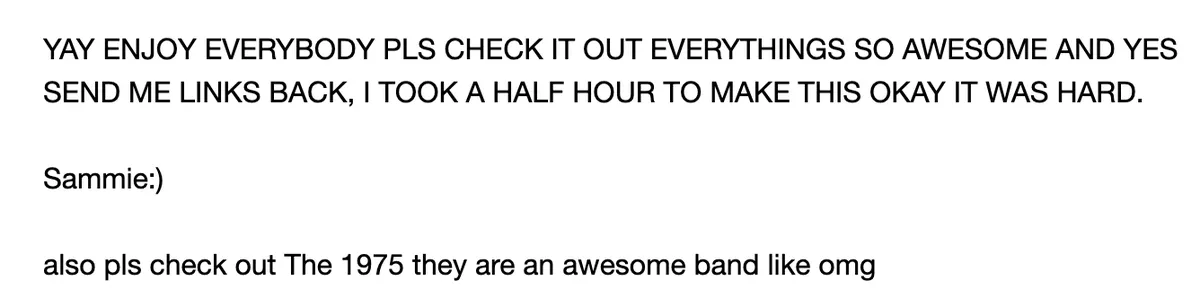
L cleaned out her childhood email account a few weeks ago and forwarded me something I wrote to her in 2013. It's a masterlist of curated links from across the internet that I created and sent to a list of my friends at age 11. In spirit it is nearly identical to the types of link round-ups and blogrolls I see all over the internet these days, my own blog included.
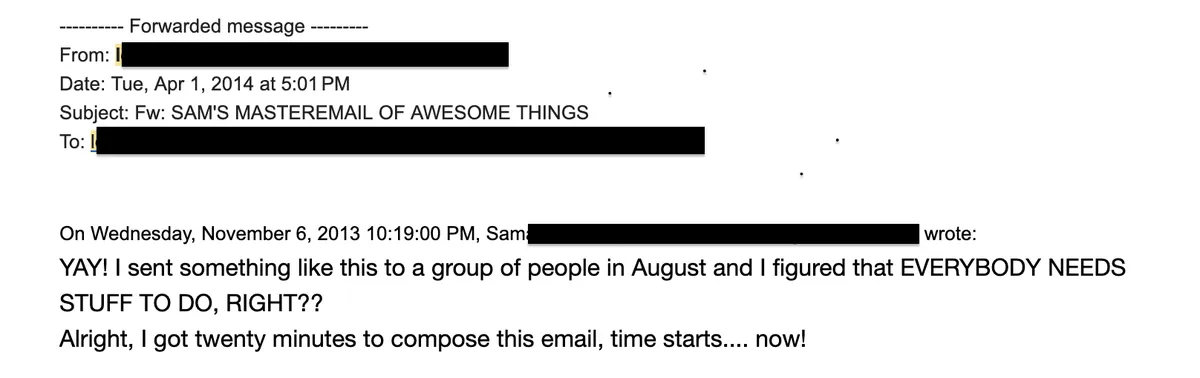 6/11/2013: the earliest childhood example of my love for internet niches
The link round-up is sorted into the categories: "for all y'all that like ta write," "random gaming," "art stuff!," and "music because yessss." It is a small comfort to think that there is likely no AI that could genuinely replicate the way eleven-year-olds wrote and spoke in the early 2010s. There are over 30 links in this email, each with their own line of middle school style commentary attached. After a brief exploration, I have found that all except two are dead.
In the collection of links for writers, "magic references," in all its retro html glory, still remains. From "Random," KoalasToTheMax is still around, and still quite lovely to mess around with1. Practically all the gaming links were obliterated due to the death of Adobe Flash. The masterlist email is a time capsule of what the internet meant to me as a young person: it was the virtual half of my world, full of endless opportunity and whimsy. It was my lifeline to art, to growth and to culture. In a space that is "supposed to last forever," it is difficult to hold on to the idea that we are killing the history of the internet. It creates this void to know that the world we came from, without physical form, no longer exists and can no longer be replicated.
and so we decay
The link rot is a symptom of the larger rot that is taking place on the web. This intentional hiding of our world's past is intended to disorient us. If the big tech internet places are continuing to exert their control over us by making their online spaces more and more oppressive, by hiding history they can trick us into believing that what we're experiencing now is Just How Things Have Always Been.
In thinking about protecting the past, I'm grateful to Brennan Brown for their post, "How are we preparing for the Long Web?," a great introduction to the web-preservation movement that's unfolding right now. I like that the tone of the post is mostly hopeful - it poises us as readers embarking on a project through time, a thought experiment into the future.
They point to some stats that highlight just how much has been lost over the past few years, one of the worst ones being that over 66.5% of links published in the last nine years are dead2. Nine years. The stats can only be more devastating if we go back twenty. Brown's post hones in on the ways that digital history is disappearing & puts together a great list of the ways that webmasters and archivists can make their sites as future-proof as possible, namely by sticking to HTML/CSS3 & updating one file, not thousands. I won't re-hash Brown's entire post, but I bring it up here as an example of the ways that the decay of the internet is being stalled and how everyday webmasters are fighting back against it.
exodus
The internet rot is also evidence of the clumping of internet users into centralized spaces. The fringe sites where we used to spend our time are missing, leading us instead to a small number of popularly visited public squares, on big tent social media. Everyone's on the same five websites, oscillating back and forth forever.4 I am of the belief that finally, after years of progressively worsening internet public spaces, the first step of reverting back to the true potential of the internet is through exodus and decentralization.
I have written about my own personal motivations for leaving the popular internet sphere here, here (with a tutorial), and here. In recognizing that I may still be in a bit of a silo, regardless I am seeing a shift among a wide range of people who are choosing to decentralize their online experiences and moving into fringe sites, personal sites, and creative uses of the web. This activity is a cyclical return to form, as proven by how many people are embracing retro aesthetics and reverting to a nostalgia for the days of dial-up.
While being a sort of self-declared romantic techno-realist, I am still not fooled by the idea that we are moving into a new age of the net that will embrace the creative, the calm and the collaborative. Rather, this shift is making me consider the ways in which we are moving post-internet.
If those of us who have decentralized are happy with our web experiences (ie. gaining inspiration, spending a 'healthy' amount of hours online, maintaining social interactions), what is the next iteration of the net that we are to work towards? What sort of digital development do we imagine, now that we are 'perfecting' our online world? My natural reaction is to think about what comes beyond.
until it's over
There's about 50 million factors that are going to affect the ways in which our digital worlds develop - some scenarios more realistic than others. I read Jacob Filipp's blog post on .yu domains last week, which evoked an existential fear in me that I hadn't yet considered. In 2010, all .yu domain names were removed from the internet, years after Yugoslavia ceased to be a 'country' as defined by the physical world. Jacob does a deep archival dive into all .yu domains and proves that not all is lost, thanks to the Wayback Machine and some insightful academic research.
It is easy for us here in the world of zeros and ones to imagine that the digital space is not at all dictated by petty physical things like so-called borders and nation-states. In the midst of recent statements by the US President, I find myself thinking now about what would happen to my beloved .ca domain if Canada ceased to exist. It's a serious vulnerability to have so much of the internet tied to physical borders. There is no telling what can be lost or changed in an instant. In imagining a digital future, we must find the way to exert control over physical spaces without fear of the dissolution or power of the state.5
Beyond states, there's corporations trying to control the future too. I found Anil Dash's "Endgame for the Open Web" post via Manuel Moreale's weekly newsletter. Anil argues that big tech and AI companies are taking over the web as we know it, and that the idea of an 'open' web will soon cease to exist due to AI slop & corporate greed impacting any services that make the web better, essentially "do[ing] to Wikipedians what Uber did to cab drivers." The article ends with a list of ways to protect the open web, but I find them all to be a touch too simplistic. Yes - certainly we should be spending energy protecting Wikipedia and the Internet Archive, I would never argue against that. But there's little consideration spent on the alternative futures that can be built - the place where the web is going that feels meaningful. The open web can be fundamentally protected by users who choose to reject profit and instead choose to embrace bizarre corners of the internet. I do believe that mainstream tech users are mostly weird and creative humans waiting to be liberated by the personal net. Big Tech can't find you if you're lurking in the shadows of a self-hosted and self-coded website. Big Tech is standing outside the gates of a place like Bearblog, desperately trying to understand why its creator/overlord and his subjects don't seem to be wanting to make ad revenue, or to write with AI. We protect the web through building independent projects, weird websites, personal displays of the heart on the internet that make people feel something. Anil finishes the post with a sentiment I echo, "if given the choice, people will pick home-cooked, locally-grown, heart-felt digital meals over factory-farmed fast food technology every time." I add that I think people will pick the human, rotting, foreign-grown, twisted and disgusting digital meals over the slop, too.
grasping for something else
The tone of Anil's post is urgent, seemingly suggesting that 2026 could be the year that we become completely dominated by the nefarious forces trying to capitalize on the internet. I would argue that this has already happened on most corners of the popular web & is certainly happening already in the physical world. It will take collaborative action for us to keep our spaces hand-made & thriving. All of us web users (fringe & mainstream) will need to work harder and care harder than we ever have before in order to protect the things that are worth protecting - namely, the right to control our own digital spaces and to keep our access to the entirety of human knowledge.
The physical and the digital are always morphing closer together, we need to make sure that neither world, in its infinite ouroboros, swallows us whole. For now, we grasp the digital parts of ourselves and catalogue them. We preserve in order to build something we can truly love.
this blog post is dedicated to L.
special thanks to my editrix AV.
reply or comment via email, if you so wish
Side note that the website creator has a small dedication written in the website's footer. So sweet. Need to make websites for people I love.↩
Recently stumbled on the writer Chris Carroll's "i was on my computer for twelve hours," which was underwhelmingly lacking in diversity of website consumption - not unlike what my life used to be before i left the Big Sites.↩
Something to said here of course for balancing this with the legal regulation of the net. In the future - how can we prevent exploitation/terrorism/all the other terrible things from taking root on the web? How can we create digital legal frameworks that will prevent these things from happening? This is beyond the scope of this blog post for now.↩